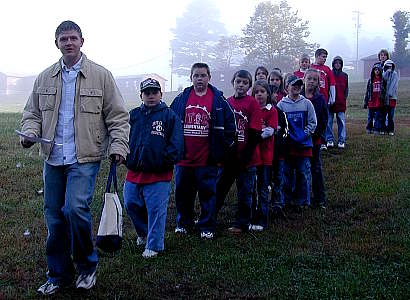
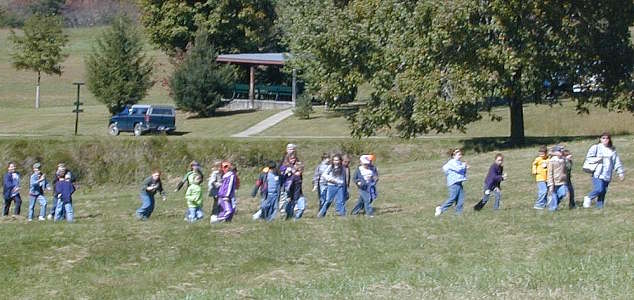
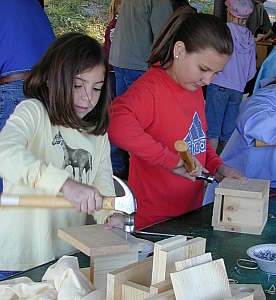
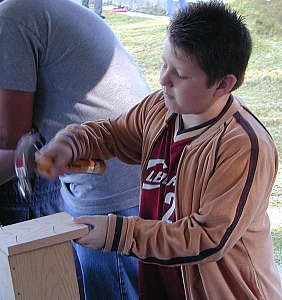
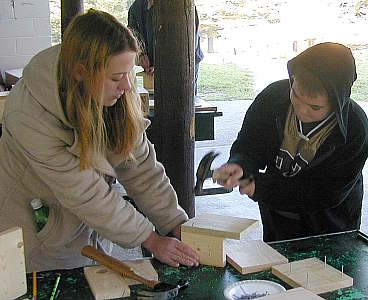
At
another they
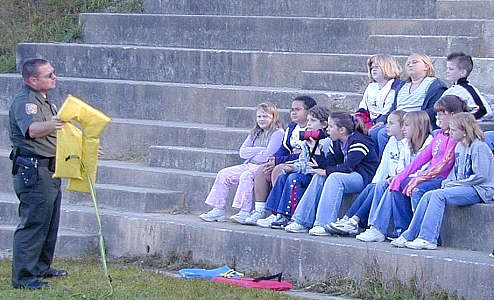
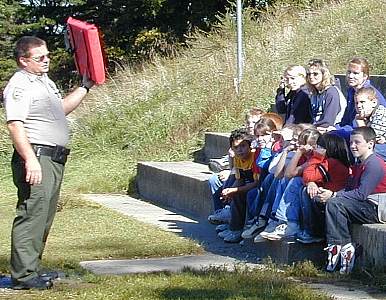
learned boating safety
and all about PFDs. That's personal floatation devices,
lifejackets, flotation cushions, and the like.
One of the favorite stops
was the
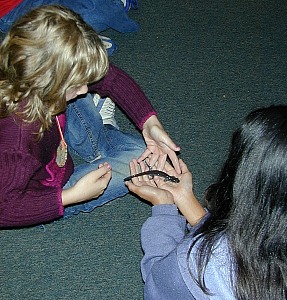
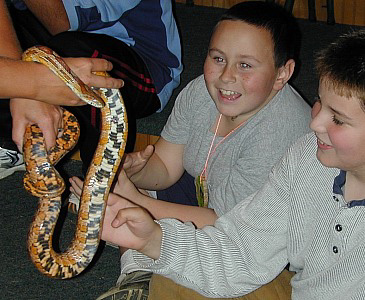
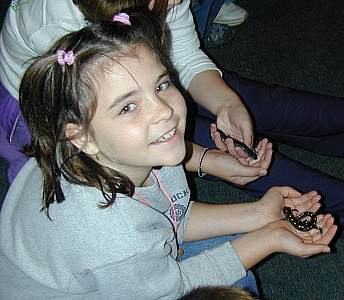
Reptiles and Amphibians station. They could look at
salamanders,
turtles and snakes and hold them if they wanted.
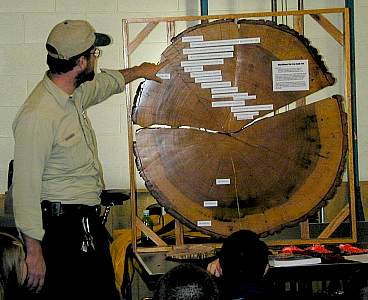
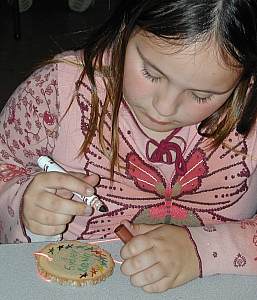
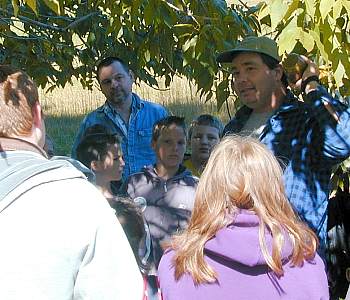
At the Tree Cookie station the kids learned about the parts of a
tree. They each determined the age of a slice of a log (tree
cookie) then decorated it and made it into a necklace.
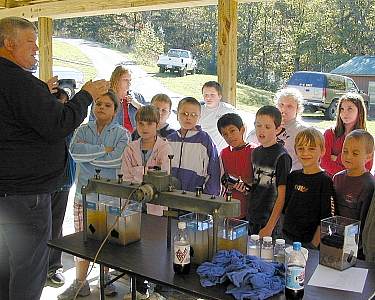
They investigated how water
is processed
to make it safe to drink at the Water Treatment station. They
talked about the various contaminants that had to be considered when
purifying water.
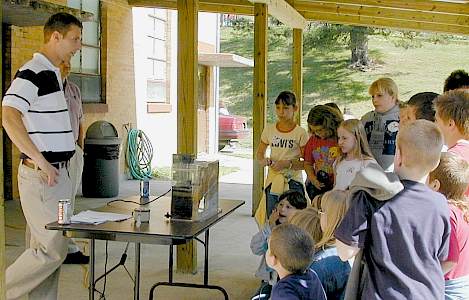
Soil Science was another station. Here the students
learn
about what is underfoot; the layers of soil, how those layers are
formed, how they are different from each other and how they are
sampled. Each class got
a jar with water, pebbles, sand, clay, and other soil components that
they could use in their classroom to see how erosion and redeposition
can create new layers in the bottom of a lake or ocean.

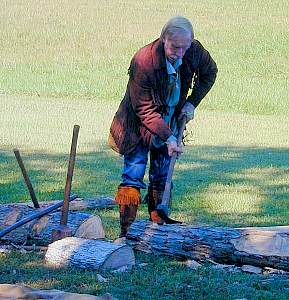
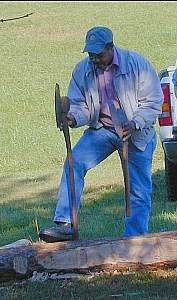
The classes saw a
demonstration of
frontier tools and how they were used to make the things that early
settlers needed. Special purpose axes, saws, and adzes were
used
to shape logs just like those that were used in building log homes.
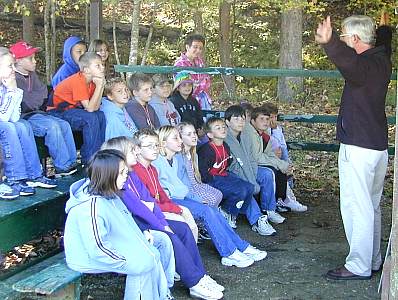
At the Wood Science station
they looked
at some of the many ways that we use forest products every
day.
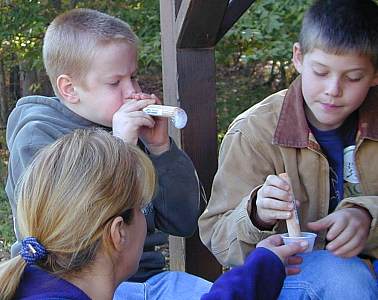
They also checked for open channels within wood samples by checking if
they could blow bubbles through them.
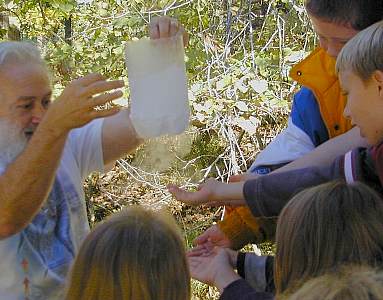
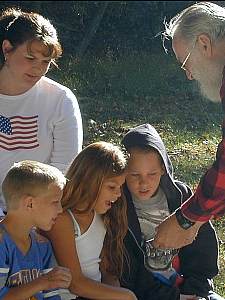
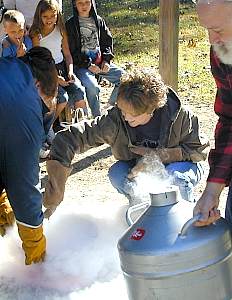
At our station the kids
were introduced
to some properties of liquid nitrogen and we then used it to
demonstrate some weather processes. We looked at and felt the
fog, clouds,
frost and snow that form when air cools near the ground or at high
altitudes. All of these are formed because when air is cooled
the
moisture it contains condenses or freezes
out. We talked about the gasses that air is made of
and the
really big
number of molecules that are in a balloon. Some of the
students
knew
that air expands when it is heated but watching a balloon cooled in
liquid nitrogen shrink to almost nothing then expand to it's original
size when allowed to warm again really brought that point
home.
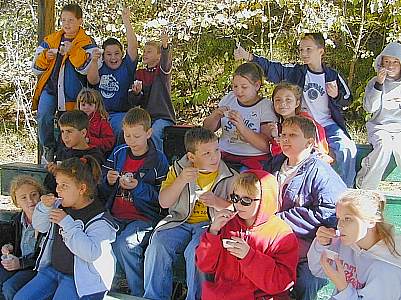
We had some fun freezing a flower and crushing it and driving a nail
into a board using a frozen banana. But the thing that I am
sure
they would all say was the best part of this stop was when their
teachers helped us make ice cream in 30 seconds or less. Well
actually, the best part was eating it. Go to our Cryogenics web page
for more
experiments with liquid nitrogen.
It is always rewarding when
we help kids
have fun learning through science.
If you want to know more
about any of
the stations or the overall program please e-mail your questions and I
will try to get the answers for you.
Go
to our Science
Fun page
Go to our Travels page
Go
to our Personal
home page
Go
to our Community
page
E-mail Nancy
and
Alan